How Estonia Became A Digital Country
What a nation of 1.3 million people can teach founders about trust, technology, and building systems that scale.
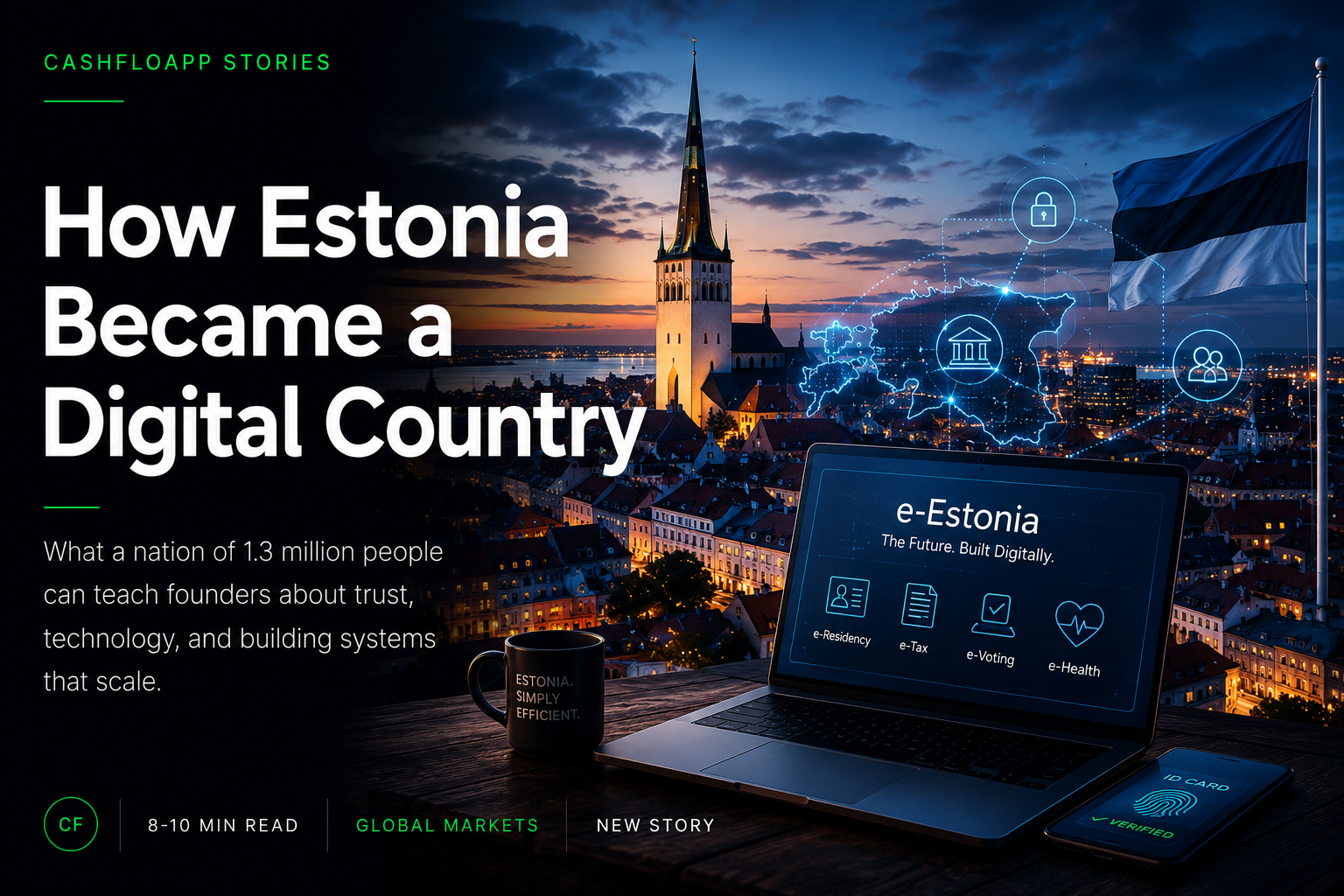
In 1991, Estonia found itself in a position few countries would envy. The Soviet Union was collapsing. The old political order was disappearing. And a small Baltic nation with barely 1.5 million people suddenly had to figure out how to survive on its own.
It wasn't rich. It wasn't powerful. It wasn't strategically important.
There were no vast oil reserves waiting to be discovered. No giant domestic market. No globally recognized corporations. No obvious competitive advantage.
If you had been asked to predict which newly independent country would become one of the world's most advanced digital societies, Estonia probably wouldn't have made your shortlist.
Three decades later, governments fly delegations to Tallinn to study how the country works. Entrepreneurs around the world open companies there without ever setting foot inside its borders. Citizens can sign legal contracts from their phones, vote online, access healthcare records digitally, start businesses in minutes, and file taxes so quickly that most people spend more time choosing what to watch on Netflix than dealing with the tax authorities.
The transformation looks like a technology story. But technology is only the visible layer. The real story is about something much more valuable.
Estonia figured out how to turn trust into infrastructure. And then it built an economy on top of it.
The Advantage Of Starting From Scratch
Most countries spend decades trying to modernize. The problem is that they must modernize while carrying the weight of everything that came before. Old systems. Old processes. Old institutions. Old assumptions. Legacy becomes baggage.
Founders know this problem well. A startup with ten employees can make a decision over coffee. A corporation with ten thousand employees might need three committees, two presentations, and six months. Size creates complexity. Complexity creates friction.
Estonia had an unusual advantage. It didn't have much legacy to protect. The country wasn't trying to digitize a century-old bureaucracy. It had the opportunity to ask a much bigger question: if we were building a country today, how would we do it?
That question changed everything. Because Estonia didn't simply move paperwork online. It redesigned how the state itself would function.
The Country That Chose The Internet
In the mid-1990s, Estonia launched an ambitious initiative called Tiger Leap. The idea was simple. Connect schools to the internet. Teach digital literacy. Prepare an entire generation for a future that hadn't fully arrived yet.
Today, that sounds obvious. In the 1990s, it was anything but. Most governments viewed the internet as an interesting technology. Estonia viewed it as infrastructure.
The distinction matters. Infrastructure changes what becomes possible. Roads create commerce. Ports create trade. Electricity creates industry. The internet creates entirely new economies.
The leaders of Estonia understood that if they couldn't compete through size, they would have to compete through speed. While many countries were still debating whether the internet was important, Estonia was quietly building the foundations of a digital society.
The lesson is remarkably similar to what we see in business. The companies that dominate tomorrow often spend years building infrastructure nobody notices today. Visa did it. Amazon did it. Stripe did it. Estonia did it too.
The Five-Minute Tax Return
There is a statistic that perfectly captures the country's approach. Most Estonians file their annual tax return in about five minutes.
Five. Not five days. Not five appointments. Not five frustrating hours searching for forgotten documents. Five minutes.
For many people outside Estonia, that sounds almost fictional. But it reveals something important. The goal of technology is not technology. The goal is removing friction.
Too many organizations confuse digitization with progress. They take a broken process and put it on a website. Estonia approached the problem differently.
Instead of asking, "How do we make paperwork digital?" it asked, "Why does this paperwork exist in the first place?" Those are very different questions. One improves the process. The other reinvents it.
The Most Important Product Estonia Ever Built
Most people assume Estonia's greatest innovation was online voting. Others point to e-Residency. Some mention digital healthcare. They're all impressive. But none are the country's most important achievement.
The most important thing Estonia built was digital identity. Every citizen has a secure digital identity that allows them to verify who they are online. That might sound boring. It's actually revolutionary.
Think about how much of modern life depends on proving who you are. Banking. Taxes. Healthcare. Contracts. Business ownership. Government services. Without trusted identity, digital systems become complicated, expensive, and vulnerable to fraud.
Estonia solved identity first. Everything else became easier afterwards.
It's the same lesson founders learn when building companies. Strong foundations create leverage. Weak foundations create problems.
The Startup Nation Nobody Talks About
Here's where the story becomes even more interesting. Because Estonia didn't just build digital government. It built an entrepreneurial ecosystem.
Today, Estonia has produced more unicorns per capita than almost any country in Europe. Not Germany. Not France. Not Spain. Estonia. A country with fewer people than Barcelona.
One of the most famous examples is Skype. Long before Zoom became a household name, Skype was transforming global communication. Although many people associate Skype with Silicon Valley, much of its engineering DNA came from Estonia.
The company's success created something even more valuable than wealth. It created experienced founders, operators, engineers, and investors — people who had seen what a global technology company looked like from the inside.
After Skype's acquisition, that talent spread across the ecosystem. New companies emerged. Then more. Then more again.
Sound familiar? It's the same pattern that produced Silicon Valley. The same pattern behind the PayPal Mafia. One successful company creates ten future founders. Those founders create twenty more. Success compounds.
Today, Estonia is home to companies such as Wise, Bolt, Pipedrive, Veriff, Playtech, and numerous other startups that most people have never heard of but millions use every day. The ecosystem didn't appear overnight. It was built.
Estonia Turned Government Into A Product
Perhaps the most fascinating example of Estonia's thinking is its e-Residency program. Imagine opening a European company without moving to Europe. Imagine accessing business infrastructure remotely from another continent. Imagine interacting with a government entirely online. That's essentially what Estonia created.
Entrepreneurs from more than 170 countries have become e-residents. The country effectively turned government into a product.
Most governments think about citizens. Estonia asked: "What if we could serve entrepreneurs globally?" It's an unusual question. And unusual questions often produce unusual outcomes.
This is precisely how innovative companies think. They don't ask how to improve existing systems. They ask how to redesign them entirely.
The Hidden Asset
People often talk about Estonia's technology, its startups, its digital infrastructure. But those are outcomes. The real asset is trust.
Citizens trust institutions. Businesses trust systems. Entrepreneurs trust regulations. Investors trust the environment.
Trust reduces friction. Friction reduces activity. When friction disappears, people move faster. Companies form faster. Decisions happen faster. Capital moves faster.
Over time, trust becomes an economic advantage. Perhaps even a competitive advantage.
This is one of the least discussed forces in business. Everyone talks about growth. Everyone talks about innovation. Everyone talks about capital. Very few people talk about trust. Yet trust sits underneath all three.
What Founders Can Learn From Estonia
The story of Estonia isn't really about Estonia. It's about design. It's about understanding that systems matter more than individual moments.
Most founders spend their time chasing outcomes — more customers, more revenue, more growth. Estonia focused on the foundations first: identity, infrastructure, trust, efficiency. The outcomes arrived later.
That's a lesson worth remembering. Because the most successful companies rarely win because they move fastest. They win because they build systems that keep working long after competitors become overwhelmed by complexity.
Three decades ago, Estonia was a small country trying to find its place in the world. Today, governments study it. Founders admire it. Entrepreneurs use its systems. And policymakers attempt to copy its ideas. Not because Estonia became larger. But because it became smarter.
Final Thought
Most countries compete for resources. Some compete for talent. A few compete for capital. Estonia chose a different path. It competed on systems.
It built a country where trust could scale. Where bureaucracy could shrink. Where technology could remove friction instead of adding it.
For a nation of barely 1.3 million people, that's an extraordinary achievement. And for founders, it contains a lesson that may be even more valuable.
You don't need to be the biggest player in the room. You need to build the best system. Everything else tends to follow.