How Singapore Built a Financial Machine
What a tiny island with no natural resources can teach founders about attracting talent, building trust, and playing a game most competitors never see.
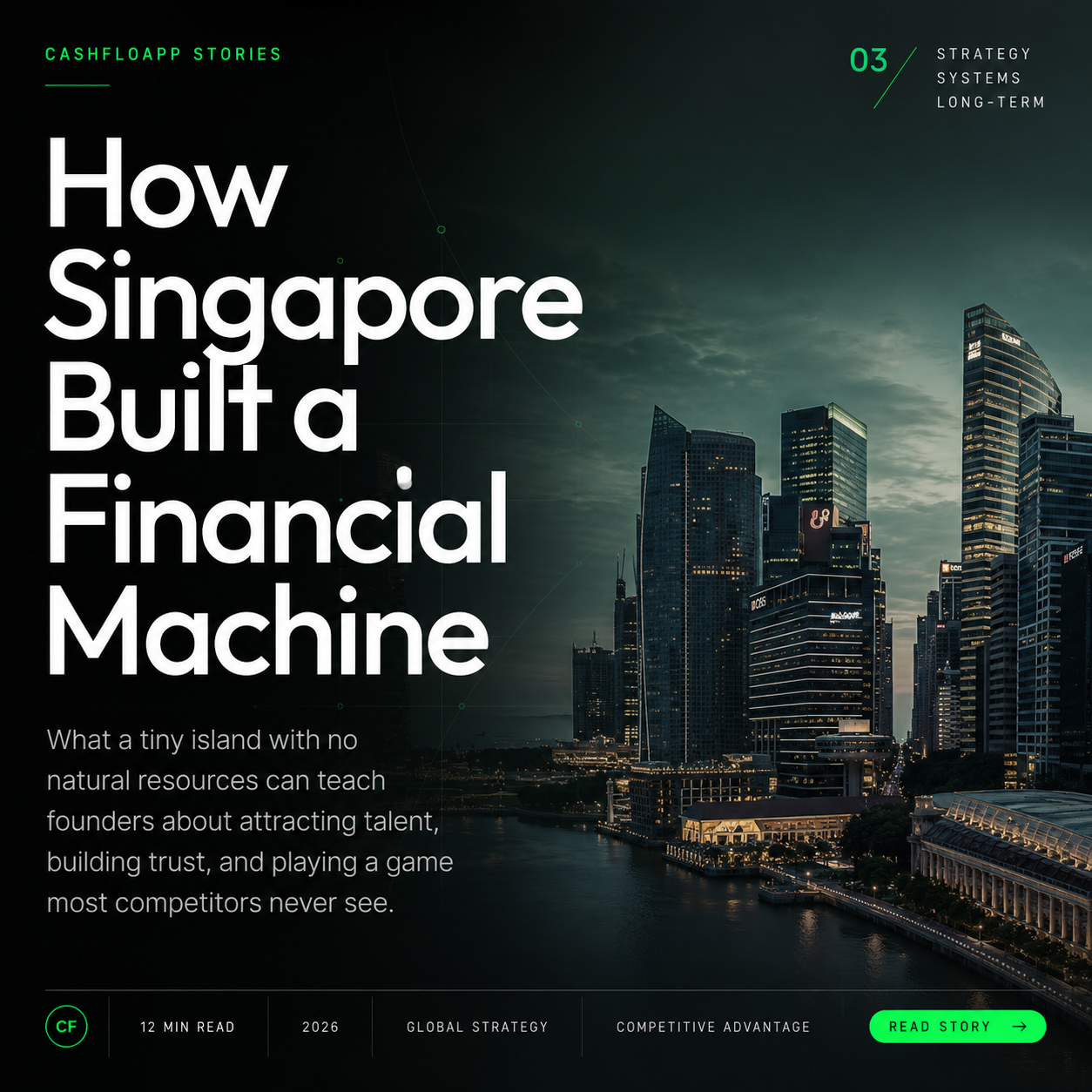
At 6:30 in the morning, the first flights begin arriving at Changi Airport.
Investors from New York, founders from London, executives from Sydney, bankers from Hong Kong, engineers from Bangalore, and family offices from Europe all pass through the same terminals.
Within a few hours, meetings will begin across the city. Funding rounds will be discussed, acquisitions negotiated, partnerships explored, and new companies launched.
Billions of dollars will quietly move through a country smaller than New York City. Nobody finds this surprising anymore. But they should.
Because sixty years ago, almost nobody believed Singapore would succeed. It had no oil, no gold, no meaningful natural resources, no large domestic market, and no obvious competitive advantage.
Today, Singapore is one of the world's wealthiest nations, one of the safest places on Earth, and one of the most important financial centers in the world. It is home to global banks, sovereign wealth funds, hedge funds, technology companies, family offices, and thousands of startups. Every year, ambitious people relocate there from every corner of the globe.
The question isn't how Singapore became rich. The question is: how did a place that seemingly had nothing become a magnet for some of the world's most valuable things?
Money. Talent. Trust.
The Man Who Refused To Accept The Obvious
In the years following independence, Singapore's future looked uncertain at best. Most leaders facing similar circumstances would have focused on survival. Singapore's founding Prime Minister, Lee Kuan Yew, thought differently.
He understood something that many founders eventually learn: the world doesn't care about your limitations. Customers don't buy products because building them was difficult. Investors don't fund companies because the odds were stacked against them. Markets reward outcomes, not excuses.
Singapore could spend decades complaining about what it lacked. Or it could build something the world wanted. Lee Kuan Yew chose the second option.
The vision was ambitious. Create a country so efficient, reliable, and trustworthy that global businesses would choose it despite its size — not because of its geography, not because of its resources, but because it became the easiest place to build.
At the time, that sounded almost impossible. Today it sounds obvious. The best strategies often look that way in hindsight.
The Resource Singapore Never Had
Most countries become wealthy because they possess something valuable: oil, gas, minerals, land, or population. Singapore had none of those.
In 1965, Singapore became independent and found itself confronting a difficult reality: a small domestic market, limited natural resources, and no obvious path to prosperity. Many countries facing similar circumstances spend decades fighting battles they cannot win. They try to compete against larger economies, richer economies, resource-heavy economies. The result is often predictable.
Singapore chose a different game. Its leaders understood something uncomfortable very early. The country would never win by competing on resources. It had to compete on systems.
That decision changed everything. While other nations focused on what was underground, Singapore focused on what could be built above it: infrastructure, education, governance, trade, and predictability. Over time, these became assets far more valuable than natural resources.
It's a lesson many founders eventually discover. When you're a small company, you rarely win by spending more money than larger competitors. You win by building better systems, faster execution, clearer processes, and better customer experiences.
Singapore did not have the resources to outspend the world. So it built an environment that was easier to trust.
The Country That Chose To Become Asia's Front Door
Singapore also benefited from geography. But geography alone never creates prosperity. If it did, countless other port cities would dominate global finance.
What Singapore did brilliantly was position itself as Asia's gateway — a place where East met West, a place where international businesses could operate with confidence, a place where capital could move efficiently.
As Asia's economies expanded, Singapore became the preferred base for companies looking to access the region. Technology firms established headquarters there, banks expanded there, and investors opened offices there. Not because they had no alternatives, but because Singapore reduced friction.
The easier a place becomes to operate from, the more valuable it becomes. The same principle applies to businesses. The easiest company to work with often wins.
The Country That Feels Like It Lives In The Future
Ask someone who has recently moved to Singapore what stands out, and the answers are surprisingly consistent. Things work. Trains arrive on time. Government services are efficient. The airport feels effortless. The streets are clean. Crime is exceptionally low. The internet is fast. Paperwork is minimal.
There is very little friction. The experience can feel almost unsettling. Many visitors describe Singapore as a place that seems to operate ten, twenty, even fifty years ahead of other cities. Not because it has flying cars, but because it removed countless small frustrations from everyday life.
That distinction matters. Most people assume progress comes from breakthroughs. Singapore shows that progress often comes from removing obstacles.
A delayed train. Complicated paperwork. Unclear regulations. Inefficient services. Each seems small in isolation. Together they become a tax on productivity. Singapore spent decades reducing that tax, and the benefits compounded. The less time people spend dealing with friction, the more time they spend creating value.
The same principle applies inside businesses. Every unnecessary process slows momentum. Every avoidable complication consumes attention. Great companies, like great cities, often succeed by making life easier.
The Global Talent Machine
One of Singapore's least discussed achievements is its ability to attract highly skilled people. Think about the challenge. The country cannot compete on size. It cannot compete on natural beauty against Australia, on history against Europe, or on scale against the United States.
Yet it consistently attracts founders, investors, executives, engineers, operators, and entrepreneurs from around the world. Why? Because it engineered an ecosystem where ambitious people can thrive: strong healthcare, excellent infrastructure, international schools, reliable institutions, safety, efficient transportation, access to capital, and a favorable business environment.
The result is powerful. A founder relocating to Singapore isn't simply moving to another country. They're plugging into a network. And networks compound. Every talented person who arrives makes the ecosystem more valuable for the next talented person.
This is how many of the world's most successful cities operate. Talent attracts talent. Opportunity attracts opportunity. Capital attracts capital. The flywheel becomes stronger every year.
Founders should pay attention to this. The best businesses often work exactly the same way. The strongest teams attract stronger teams. The best customers attract better customers. The most trusted brands attract more trust. Everything compounds.
Trust Became The Product
Most people think Singapore became a financial center because of banking. The reality is the reverse. Singapore became a banking center because people trusted it.
Trust is difficult to measure, but its effects are obvious. Investors trust contracts. Companies trust regulations. Executives trust long-term planning. Entrepreneurs trust the legal framework. Global institutions trust the environment. When enough people trust a system, capital follows. And where capital goes, opportunity usually follows.
“Singapore's greatest export was never finance. It was trust.”
Trust attracted businesses. Businesses attracted talent. Talent attracted investment. Investment created growth. Over time, trust became a competitive advantage. Then it became an economic engine.
Many founders underestimate the importance of trust because it rarely appears on financial statements. Yet trust influences almost every outcome — customer retention, hiring, partnerships, referrals, valuations, and brand reputation.
Trust compounds just like capital. The difference is that trust is often harder to build and easier to lose.
The Founder Lesson Nobody Talks About
This is where Singapore becomes relevant to business owners. Founders often ask: how do we grow faster? How do we get more customers? How do we increase revenue?
Singapore asked a different question. How do we become the obvious choice? That's a completely different game.
Instead of competing on price, Singapore competed on certainty. Instead of competing on size, it competed on reliability. Instead of competing on resources, it competed on execution.
The same principle applies to companies. The strongest businesses often win because they become predictable. Customers know what they'll get. Employees know what to expect. Investors understand the vision. Partners understand how the company operates. Trust compounds, just like capital.
Look at Stripe. Customers don't use Stripe because payment processing is exciting. They use Stripe because it works. Reliability became the product. Singapore followed a remarkably similar playbook.
The Hidden Advantage Of Safety
One aspect rarely discussed in economic analysis is safety. Singapore consistently ranks among the safest places in the world. At first glance, this feels unrelated to business. It isn't.
People take bigger risks when they feel secure. Founders launch companies. Investors deploy capital. Professionals relocate their families. Executives commit long-term. Entrepreneurs make ambitious bets.
Safety creates confidence. Confidence creates economic activity. Economic activity creates growth.
Again, it comes back to trust. A safe environment reduces uncertainty. Reduced uncertainty encourages investment. And investment creates opportunity. This is one of the least discussed but most powerful advantages Singapore built over time.
What Everyone Gets Wrong
People look at Singapore today and see skyscrapers, banks, wealth, luxury — the visible outcome. What they miss are the decades of decisions underneath: the infrastructure, the institutions, the planning, the discipline, the consistency, and the willingness to prioritize long-term outcomes over short-term popularity.
The same mistake happens in business. Founders admire successful companies without studying the systems that created them. They see the result, not the process. They see revenue, not the infrastructure producing it. They see growth, not the discipline sustaining it. They see success, not the decades of execution behind it.
Singapore reminds us that outcomes are usually lagging indicators. The real story is almost always hidden beneath the surface.
The Decision
If you're building a business, stop asking: how can we become bigger?
Start asking: how can we become more trusted? How can we become easier to work with? How can we reduce friction? How can we attract exceptional people? How can we create an environment where customers, employees, and partners want to stay?
Because that's what Singapore built. Not a financial center. A trust machine. The money arrived later.
Final Thought
Singapore's greatest achievement wasn't becoming rich. Lots of places become rich. Its greatest achievement was becoming trusted — trusted enough that investors send capital, trusted enough that founders relocate, trusted enough that talented people build their lives there.
For a country that started with almost nothing, that's an extraordinary outcome. And for founders, it contains a lesson worth remembering.
The most valuable thing you can build isn't revenue. It's confidence. Everything else tends to follow.