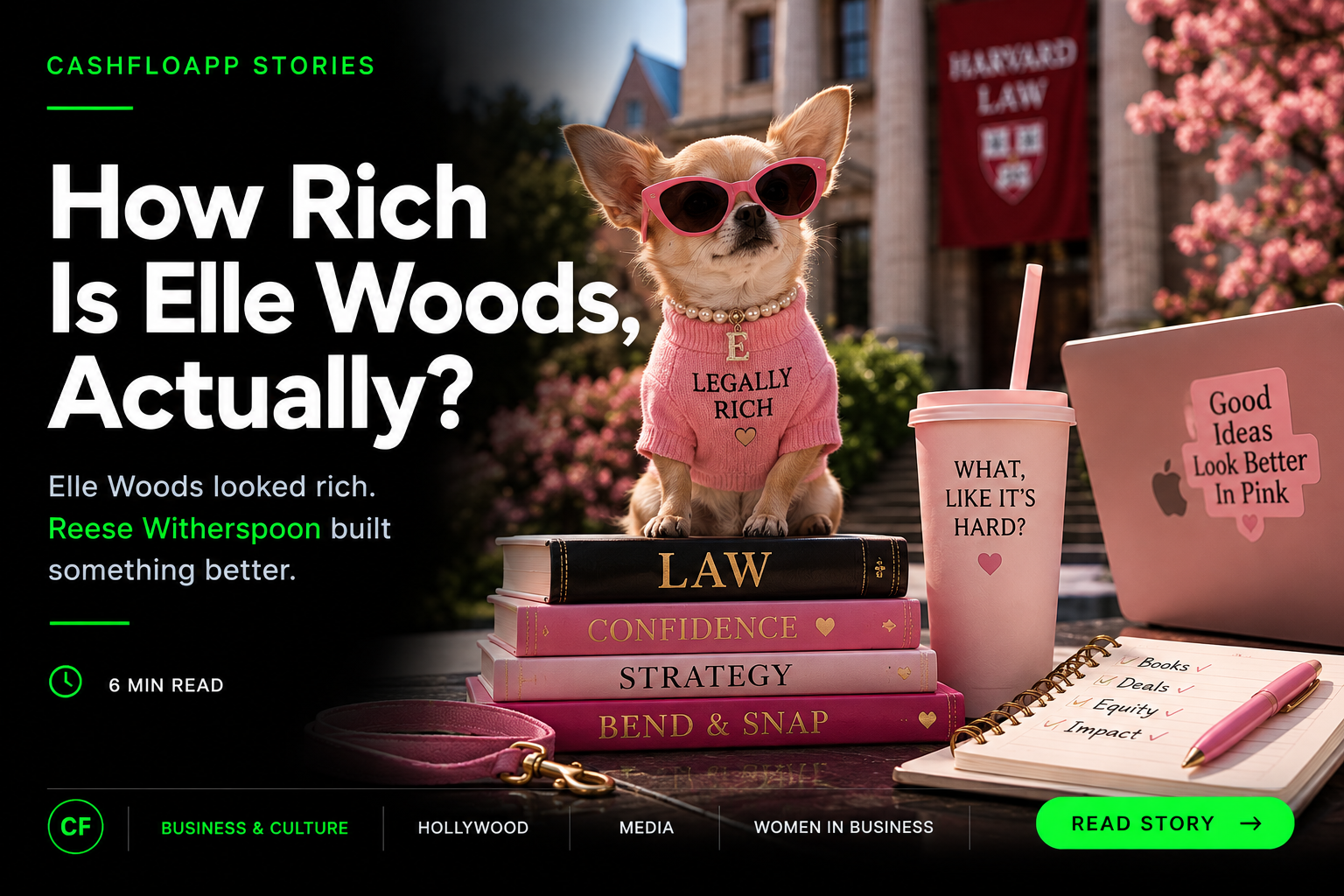
How Rich Is Elle Woods, Actually?
Elle Woods looked rich. Reese Witherspoon built something better.
Let's Price the Sorority Formal
Elle Woods never once worries about money. Not when she's buying a going-away outfit for Harvard, not when she's flying cross-country on a whim, not when she's redecorating her dorm room like it's a guest suite at a boutique hotel. In the entire runtime of Legally Blonde, nobody mentions a budget. That, itself, tells you something.
So let's take the movie at its word and actually price her life. Call it The People v. Elle Woods' Trust Fund.
Elle's family lives in a large house in a wealthy stretch of Bel Air and treats a sorority formal like a minor production. Delta Nu dues, event costs, the wardrobe alone — a real sorority membership in 2001 likely ran a few thousand dollars a year, easily north of that once you factor in the clothes Elle's character seems to replace weekly. Then there's Harvard Law School itself. Tuition for the 2001–2002 academic year was $27,500, and it never once comes up in conversation. What, like it's hard?
So what would it actually cost to be Elle Woods?
Harvard Law's own estimated cost of attendance for that era — tuition plus Cambridge housing, food and books — came to roughly $44,500 a year; call it $133,500 for the three years of law school the film covers, before Elle earns a single dollar back. Add a conservative allowance for the cross-country flights she takes more than once without blinking, a sorority membership and its accompanying social calendar, and a wardrobe that appears to operate on a strict no-repeat policy, and a defensible, still-conservative total for the version of Elle's life the movie actually shows us lands somewhere in the neighborhood of $160,000, in 2001 dollars. Adjusted for inflation, that's something in the range of $290,000 today. We're rounding generously in Elle's favor throughout, and we're not counting the four years of undergrad that got her into Harvard in the first place.
None of this tells us what the Woods family was actually worth — the film gives us Elle's spending, not her balance sheet. But it does answer the question on the cover: being Elle Woods was not merely comfortable. It was expensive, in a specific and trackable way, and money is so settled in her background that her actual obstacle, being underestimated, can be taken seriously as the real one.
“Elle Woods wasn't just comfortable. She was rich in the particular way where a quarter-million-dollar legal education never becomes part of the conversation.”
Unfortunately for the rest of us, Elle had the considerable financial advantage of not existing.
We've Been Pricing the Wrong Blonde
Here's the thing about spending an afternoon costing out a fictional sorority girl's law degree: however satisfying the math is, it's still the wrong exercise.
The actress who played her did something considerably more interesting with her own money. Elle Woods got to be rich in the movie. Reese Witherspoon got rich making it — and then, a decade and a half later, decided that wasn't actually the part worth keeping.
Being Famous Isn't the Same as Owning the Show
By the early 2000s, Witherspoon was one of the biggest actresses in America. Legally Blonde alone made more than $140 million on an $18 million budget. She won an Oscar in 2006. She was, by any normal definition, extremely successful. An Oscar, it turns out, does not fix unit economics.
She was also, by her own account, running into the oldest problem in Hollywood: being handed a script only after everyone above her had already decided what it was worth, who would direct it, and what she'd be paid to show up. In 2000 she'd started her own production company, and by 2012 she'd merged it into a bigger one, chasing better material because the material studios were sending her wasn't good enough. It worked, creatively — that partnership produced Gone Girl, Wild, and HBO's Big Little Lies, three Oscar nominations and hundreds of millions at the box office between them. Financially, it barely worked at all. "I was only working for producer fees," she later said of that period. "The overhead was eating me alive. That's not a real business."
Notice what that sentence is actually describing. It isn't that a salary is bad and ownership is good. It's that Witherspoon was still arriving late to her own projects — brought in to produce and star after a book had already been optioned, a script already drafted, most of the important decisions already made by someone else. Producing got her closer to the material. It didn't get her early enough.
The Book Club That Became a Balance Sheet
In 2016, Witherspoon tried something different. She and business partner Seth Rodsky founded Hello Sunshine, built around a broader idea: stop waiting for the industry to hand you a finished decision, and go stand closer to where the decisions actually get made.
That's the real shift, and it's worth being precise about it, because it's more interesting than "she started owning things." Witherspoon spent two decades moving from actress to producer to something closer to a talent scout with a distribution deal — each step putting her a little closer to where a story actually gets discovered, rather than the moment it gets cast.
Reese's Book Club is the clearest version of that move, and it's worth walking through plainly, because the mechanism is more interesting than the vibe of "celebrity recommends novels."
Step one: Reese picks a book, often one most people haven't heard of yet, and puts it in front of an audience of millions across Instagram and the book club's own platforms. Step two: people actually buy it. Where the Crawdads Sing had a first printing of just 28,000 copies before Witherspoon picked it in September 2018; within two years it was one of the best-selling novels in the country. That's not luck. It's a large, engaged audience voting with actual money, which means Hello Sunshine gets to watch demand happen in real time instead of guessing at it. Step three: Hello Sunshine goes to the book's publisher and options the screen rights — typically after the pick has already done its work proving there's an audience, not before. Step four: Hello Sunshine develops the adaptation, attaching a writer and a showrunner and deciding what the thing actually becomes. Step five, and this is the part people tend to miss: Hello Sunshine doesn't own a network or a streaming platform, so it still has to sell the finished package to somebody who does. Hulu bought Little Fires Everywhere. Sony released Where the Crawdads Sing in theaters. Amazon took Daisy Jones & The Six. Hello Sunshine isn't a mini-studio quietly building its own Netflix. It's the company standing in the middle of that whole chain, holding the rights and the relationship with an audience that shows up already primed to watch whatever comes out the other end. A book club pick that takes off isn't just good publicity. It's data, and eventually leverage.
“It's not quite bend and snap. But it's the same basic idea: find the move that works, then repeat it before anyone else clocks what you're doing.”
To be clear about what this doesn't mean: not every book club pick becomes a Hello Sunshine project, and a producer's leverage in Hollywood usually comes from being the one who found the material and controls who adapts it, not from owning it outright. But that leverage compounds in a way a flat fee never does. A producer fee ends when the project wraps. A company that keeps finding the next story doesn't have that problem.
By 2021, that position was valuable enough that Blackstone came calling. A media venture backed by the private equity giant and run by two former Disney executives bought Hello Sunshine in a deal reported at roughly $900 million. Blackstone put in more than $500 million in cash to buy out existing investors, including AT&T and Laurene Powell Jobs' Emerson Collective. Witherspoon didn't fully cash out — she and Hello Sunshine's CEO retained equity stakes and stayed on to run the company inside the new structure, which was later named Candle Media.
Objection: Reese did not make $900 million. That number is what Blackstone's venture paid for the company as a whole, not a figure that landed in Witherspoon's bank account. Forbes estimates she retained roughly an 18% stake in the business, and, as of mid-2025, put her total net worth at $440 million. Forbes also estimates that her remaining Hello Sunshine stake is now worth less than half what it was at the time of the sale, as the company's revenue has reportedly declined. Company valuation, ownership percentage, and personal net worth are three different numbers, and collapsing any two of them into one is exactly how a $900 million headline turns into a myth.
What's verifiable is the shape of the move itself. Witherspoon didn't stop being an actress, and she didn't simply trade a salary for a stock certificate. She spent years getting closer to the point where a story gets chosen in the first place, rather than the point where someone gets cast in it. Equity gives you a claim on where that process leads. It also, unfortunately, remembers to bring the downside along with it. Candle Media has had a rockier few years since 2021 than the initial headline suggested — the wider streaming market cooled, and reporting in 2024 and 2025 described Blackstone reviewing and restructuring parts of the Candle portfolio.
“Getting closer to where the decisions are made doesn't mean you stop taking risks. It means you start taking a different set of them.”
What Elle Woods Actually Won
There's a decent chance Legally Blonde itself is worth more today than it looked in 2001. It spawned a sequel, a long-running Broadway musical, an entire cultural shorthand around being underestimated, and — after years of on-and-off development — a long-rumored third film. Amazon also produced Elle, a prequel series following Elle Woods through high school, from Witherspoon and Hello Sunshine; it premiered on Prime Video in July 2026 and was renewed for a second season before Season 1 even aired. None of that comes close to $900 million. But it's a reminder that even the original movie, the one that made Elle Woods rich only inside the story, turned out to be intellectual property with a life well beyond its opening weekend — and that this time, unlike the first, Witherspoon wasn't just starring in it. She was one of the people who decided it got made at all.
Elle Woods spent an entire movie walking into rooms where people had already decided what she was worth.
Reese Witherspoon spent the next twenty-five years changing where she sat in the room.
“Elle got into Harvard. Reese got onto the other side of the deal.”