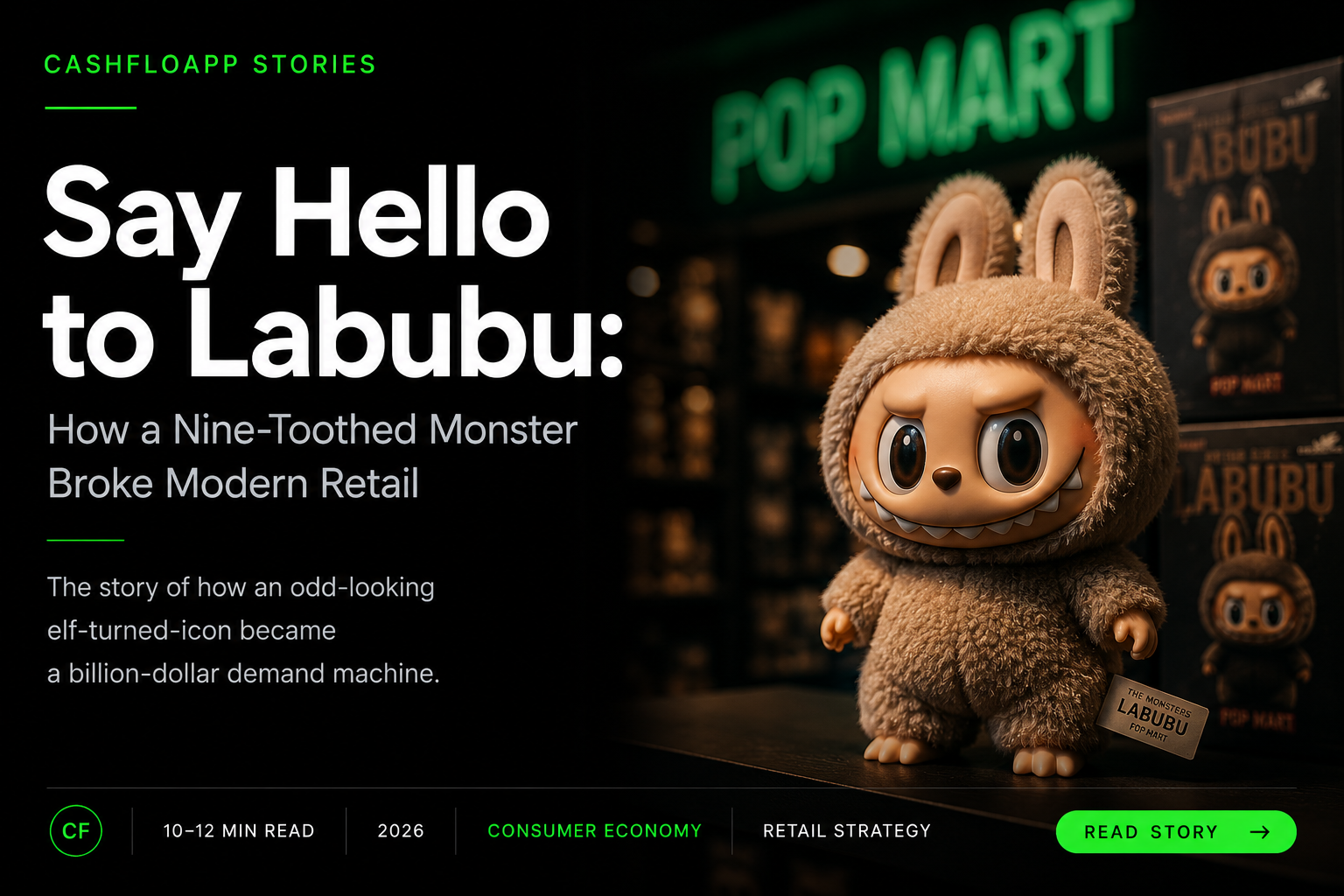
Say Hello to Labubu: How a Nine-Toothed Monster Broke Modern Retail
The story of how an odd-looking elf-turned-icon became a billion-dollar demand machine — and what it reveals about how the best modern businesses actually work.
Somewhere in Bangkok, a woman has been queuing since 4 a.m. for a product she is not allowed to choose.
She knows roughly what she's getting — a small plush toy, palm-sized, part of a themed series. She does not know which one. That detail is not a flaw in the retail experience. It is the retail experience. She will pay, open, and react. If she gets the rare variant — appearing in roughly one of every seventy-two boxes — she could resell it for twenty times what she paid. If she doesn't, she'll probably buy another box.
Think about what that sentence just described. A consumer, voluntarily, in a queue, excited, spending money on something she cannot see, in a format designed to frustrate her. And she came back the next week.
“This is not an accident. This is architecture.”
Amazon spent twenty years perfecting the ability to find you exactly what you want, the moment you want it, delivered before you've finished wanting it. Pop Mart built a multi-billion-dollar company by doing the opposite. Every retail executive in the world has spent their career removing friction from shopping. Pop Mart added it, monetized it, and is currently worth more than Mattel and Hasbro combined.
“Every retail executive in the world has spent their career removing friction from shopping. Pop Mart added it.”
Here's where it gets genuinely strange. In 2024, Pop Mart's revenue more than doubled to 13.04 billion yuan — roughly $1.81 billion. Labubu plush toy sales alone were up over 1,200%. By the first half of 2025, the company's revenue and profit for those six months had already surpassed its entire 2024 full year. The stock is up 650% in twelve months. Pop Mart's gross margin sits at 70% — more than double the 32% of its nearest competitor.
“A creature with nine teeth did this.”
So the question — the one nobody asking about toys is actually asking — is: what business is Pop Mart really in?
The Artist, Briefly
Kasing Lung grew up in Hong Kong, emigrated to the Netherlands at seven, and spent his childhood reading picture books about elves because his Dutch was too poor for anything else. He became a serious illustrator, eventually won Belgium's national Illustration Award — the first Chinese artist to do so — and in 2015 began sketching a creature in his notebooks that he described as kind-hearted but accident-prone. A character who wants to help but keeps making things worse.
That internal contradiction — menacing outside, gentle inside — is commercially important in ways Lung probably wasn't thinking about. The teeth look like a threat. The story says they're a smile. That tension creates something you want to look at twice. You want to resolve it. And the act of resolving it — deciding that actually, Labubu is charming — makes you feel like you discovered something.
“That's not a toy. That's a relationship.”
For four years, Labubu existed only in niche art books. Then Wang Ning arrived, licensed the character, and made one promise: he would not change the design. Only improve the production. Which sounds modest, until you understand why it was the most important business decision he made.
The Retailer Who Read the Room
Wang Ning opened a small store in a Beijing shopping mall in 2010. The concept was vague — designer toys, curated, minimalist. It didn't work particularly well until 2016, when he licensed a character called Molly from a Hong Kong artist and sold 80,000 units in twenty days. That was the moment he understood something most retailers never do: people weren't buying objects. They were buying attachment.
A toy entertains a child. A character becomes part of an adult's identity. Those are entirely different businesses. One competes on features. The other competes on feeling.
Wang Ning's promise not to modify Kasing Lung's designs wasn't artistic generosity. It was commercial precision. The value of Labubu lives in her specificity — the exact wrongness of the teeth, the particular proportions, the fact that she looks like nothing else. Domesticate that, round it off, make it more acceptable, and you've destroyed the only thing that makes it worth owning. He understood that the strangeness wasn't a risk to manage. It was the product.
By December 2020, Pop Mart was listed on the Hong Kong Stock Exchange at a HK$100 billion valuation. It had Molly, Dimoo, Skullpanda, and a growing roster of artist-licensed characters. What it didn't yet have was a phenomenon.
That required an Instagram story.
The Spark, and Why Credit Goes to the Wrong Person
In April 2024, BLACKPINK's Lisa posted a photograph hugging a giant Labubu doll to 106 million followers. It wasn't a paid campaign. At the time, Labubu wasn't particularly hard to find — you wouldn't even need to queue. Within weeks, stores were empty. Secondary prices were exploding. Rihanna was photographed with one on a Hermès Birkin. The queues outside Pop Mart stores began.
Every version of this story gives Lisa the credit. That's the wrong analysis.
Lisa's post was an accelerant. The fuel was already there. By April 2024, Labubu had already developed the cultural grammar required to become a status object — it was coded as rare, slightly inaccessible, and visually transgressive in a way that signaled taste rather than commerce. The celebrities didn't create that meaning. They ratified it. Manufactured hype collapses when you look at it directly. What Lisa amplified was something that already had its own internal logic.
The more interesting question is how that internal logic got built. And the answer is that Pop Mart had been carefully constructing it for years through a mechanism most people still describe incorrectly as a gimmick.
The Box Is Not the Product
“The box is not the product.”
Here is a reframe that changes everything: Pop Mart is not selling toys in mysterious packaging. It is selling the experience of anticipation, and the toy is proof that the experience happened.
“Pop Mart is selling the experience of anticipation, and the toy is proof that the experience happened.”
The mechanism is variable ratio reinforcement — the same behavioral schedule that makes slot machines resistant to abandonment, and the most powerful reinforcement pattern identified in a century of behavioral psychology. A fixed reward ends the loop. Buy something, receive it, loop closed. A variable reward perpetuates it indefinitely. You don't know when the good outcome arrives, so you keep going.
What makes Pop Mart's application of this particularly elegant is the layering. The dopamine peak doesn't arrive when you get what you want. It arrives right before you open the box. Pop Mart has industrialized the moment before the reveal and charged retail price for it.
The "secret" variant — appearing at roughly one in seventy-two — isn't arbitrary. That probability sits in the specific range known to produce the strongest anticipation and the most persistent behavior. Too rare and people give up. Too common and it loses meaning. Someone made that choice deliberately. It was a calibration, not a curiosity.
And here's what most analyses miss entirely: the resale market isn't a side effect of Labubu's success. It's a structural part of the business model. When a Labubu resells for five hundred dollars, it tells everyone who paid twenty-eight that they acquired something real. It tells everyone who hasn't bought one that they're behind. The secondary market is Pop Mart's most effective advertising — and it costs them nothing.
“The secondary market is Pop Mart's most effective advertising. And it costs them nothing.”
This is where the story stops being about toys.
What Pop Mart Is Actually Building
Pop Mart's 70% gross margin is not a toy company margin. For context: Top Toy, its nearest domestic competitor, runs at 32%. The difference is not operational efficiency. It's IP ownership.
Top Toy licenses Disney and Sanrio characters. It pays royalties. Pop Mart owns its characters outright. When you sell something you own rather than something you rented, the economics are structurally different. This is why Pop Mart's market capitalization — approximately $37.85 billion as of mid-2025 — sits far above Mattel ($5.1 billion) and Hasbro ($8.7 billion), and near Sanrio ($41.43 billion). The market isn't pricing Pop Mart as a toy company. It's pricing it as an IP company that happens to distribute through retail.
“The market isn't pricing Pop Mart as a toy company. It's pricing it as an intellectual property company.”
Walt Disney sketched his business model in 1957: theatrical films at the center, with merchandise, parks, television, and licensing radiating outward. The content creates the character; the character earns in every direction, indefinitely. It was the original perpetual motion machine for consumer brands. Pop Mart is building toward exactly that structure, but starting from the other end — merchandise first, content later.
Pop Mart Films is developing an animated series, Labubu and Friends, which registered its copyright in March 2025. Pop Land, the Beijing theme park, spans 40,000 square meters and is doubling in size. The company has 140 stores overseas with plans to exceed 200 by year end, expanding into the Middle East, Latin America, and Central Europe.
The strategic logic is straightforward: if Labubu exists only as a collectible, its value depends entirely on trend. If Labubu exists as a character with stories, films, and theme park experiences, it becomes infrastructure. Hello Kitty has earned money for Sanrio for fifty years. Sanrio's most famous character has no personality, no storyline, and no mouth. The character doesn't need to say anything. It just needs to mean something. That's what Pop Mart is trying to build.
Why Asia, and What It Reveals
The Labubu phenomenon didn't emerge randomly in Southeast Asia. It emerged in a cultural ecosystem that already had the grammar for what Pop Mart was selling.
Japan's gashapon culture had spent decades making random-capsule vending machines a normal part of daily life. K-pop fandoms had developed extraordinarily sophisticated behavior around limited-edition photocards — obsessing over pull rates, trading duplicates, celebrating rare variants. These communities weren't just consumers. They were already trained collectors operating inside a scarcity economy built on exactly the same psychological mechanics as blind boxes.
Pop Mart didn't invent any of this. It synthesized it, elevated it, and then exported the whole system westward — with Southeast Asia as proof of concept. Overseas revenue grew 375% in 2024. Southeast Asia was up 619%. North America up 557%. Pop Mart replicated the same playbook in each market: controlled initial supply, concentrated retail presence, drop schedules, community events, queues. The formula is repeatable because the psychology is universal. The cultural context differs. The dopamine response doesn't.
The Fakes Prove the Point
No brand becomes real until it has a convincing fake. Labubu has an entire industry of them.
"Lafufus" are manufactured in factories in Guangdong and Hebei and sold domestically and overseas at a fraction of retail price. Chinese authorities have seized more than 1.8 million counterfeit dolls intended for export this year. UK authorities seized £3.5 million worth of fakes, many failing safety tests. In Manhattan, they're sold off blankets on the sidewalk.
Here's the thing about counterfeits that nobody says plainly: they only exist at scale when the authentic version carries enough cultural status that people want the signal even without the substance. Lafufu isn't a threat to Labubu's brand equity. It's a measure of it. When a 28-year-old fan buys a fake at a Florida gas station for $20 because the real thing feels like the Hunger Games to acquire, she isn't undermining Pop Mart. She's confirming that its cultural logic has traveled further than its distribution.
The longer-term question is more uncomfortable. When authenticity becomes accessible only to the wealthy and the devoted, a brand faces a choice: evolve into genuine luxury — with luxury margins and luxury selectivity — or watch aspiration evaporate as the mainstream moves on. Pop Mart is currently betting on expansion. Whether it can preserve scarcity's tension while opening stores aggressively across four continents is the central challenge of the next five years.
The Risks, Stated Plainly
Pop Mart's CEO called hitting 30 billion yuan in 2025 revenue "quite easy." That deserves scrutiny rather than applause.
Labubu now accounts for an estimated 26–44% of Pop Mart's first-half 2025 revenue, up from 23% for the full year 2024. That is extraordinary concentration in a single character for a company pricing itself as a diversified IP platform. It's the kind of number that makes an investor check the footnotes.
Social data is already flashing yellow. Labubu mentions peaked across Asia Pacific in September 2025 and by December had fallen behind Hello Kitty. Secondary market resale prices are down more than 50% from peak. "The brand has entered correction territory," according to Humphrey Ho at Helios & Partners.
The Beanie Babies ghost hovers over every conversation about Labubu — a collectible that generated enormous secondary markets, then collapsed when the company miscalibrated supply and sentiment turned. The difference between Beanie Babies and Hello Kitty is not design quality. It is depth. Hello Kitty became a canvas for infinite cultural expression. Beanie Babies were cute animals in a speculative moment. The question for Pop Mart is which one Labubu becomes. The animated series and theme park are, in that light, not entertainment diversification. They're insurance.
What This Is Really About
Pop Mart didn't build a better toy. It built a desire infrastructure — a system in which behavioral psychology, engineered scarcity, community identity, and IP ownership converge around a small plush object.
The object is almost incidental. What people actually buy when they buy a Labubu is the ritual of the unboxing, the status on the bag strap, the membership in a community of people who know what it is, and the feeling — genuinely rare — of not knowing what you're going to get.
Every retail executive in the world should find that last point unsettling.
The conventional assumption — the one baked into thirty years of e-commerce optimization — is that consumers want more choice, more certainty, more control. Amazon, Netflix, Spotify: the entire architecture of modern consumer technology is built on the premise that preference satisfaction is the goal. Pop Mart discovered, at scale, that certainty can actually be the enemy of desire. That sometimes what people want is not to choose — they want to feel something. And removing control is an extremely effective way to manufacture feeling.
“Certainty can actually be the enemy of desire.”
This matters far beyond Pop Mart. The companies generating the most durable economic value in the early twenty-first century are not competing on products. They are competing on desire, identity, belonging, and anticipation. Apple sells tribe membership. Nike sells self-narrative. Hermès sells exclusion as aspiration. Pop Mart sells the feeling of opening a sealed box in a world that has otherwise engineered all surprise out of shopping.
“The companies generating the most durable economic value are not competing on products. They are competing on desire, identity, belonging and anticipation.”
Kasing Lung drew an elf with too many teeth in a notebook above a restaurant in the Netherlands, trying to make something that felt honest. Wang Ning looked at it and saw something different: a system. A way to make desire scalable.
They were both right. That's what makes it interesting.
The creature with nine teeth didn't just become a product. It became a window into how the best modern businesses actually work — not by making things people want, but by making people want things in ways they can't quite explain.
Once you see that machinery, you see it everywhere. In the drop culture of sneakers. In the waitlist for a Birkin. In the pull rates of a Pokémon booster pack. In the queue at 4 a.m. in Bangkok.
“We thought we were reading about a toy. We were reading about desire itself.”