The Cost Of Looking Successful
Why founders often spend money to signal success, and why that habit quietly destroys more businesses than most people realize.
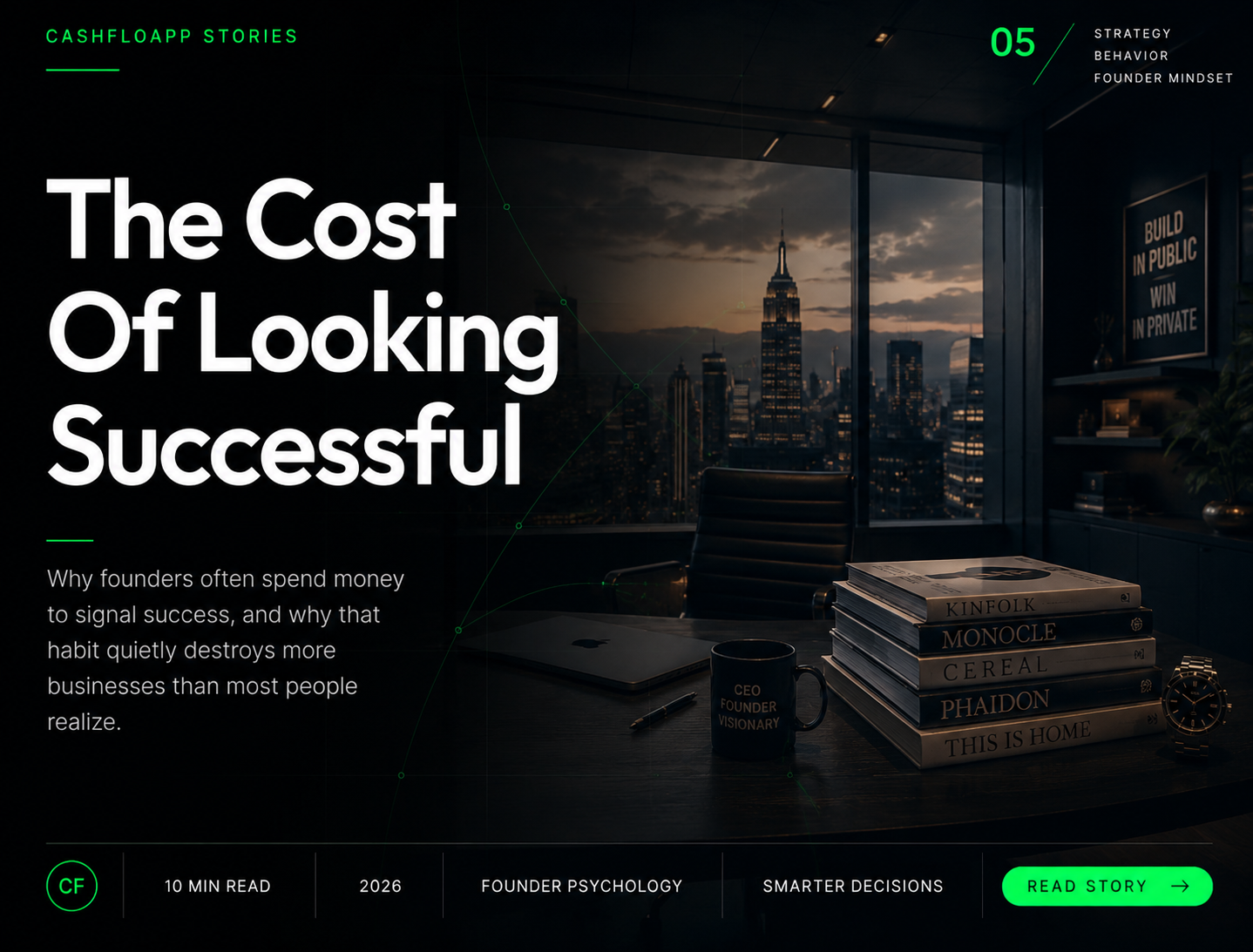
Walk through almost any major city and you'll see them. The agency with the glass-walled office. The startup founder posting photos from a conference in Dubai.
The consultant arriving at a client meeting wearing a watch worth more than most people's monthly salary. The SaaS company announcing a new headquarters, a new funding round, and a new hiring spree all in the same quarter.
From the outside, it looks impressive. Successful, even. But appearances can be deceptive.
Behind many of these businesses sits a reality that rarely appears on LinkedIn: the runway is shrinking, margins are thin, revenue is growing slower than expected. The founder hasn't taken a proper salary in months. The bank account is carrying more stress than confidence.
This isn't a story about irresponsible spending. It's a story about something far more common. It's a story about signaling. And it might be one of the most expensive habits in modern business.
The Business Of Looking Successful
Every founder understands that perception matters. Customers need confidence. Employees need confidence. Investors need confidence. Partners need confidence. A business that looks unstable often becomes unstable. That part is true.
The problem begins when founders start confusing confidence with appearances. A beautiful office is mistaken for culture. A large team is mistaken for momentum. A luxury lifestyle is mistaken for competence. A busy calendar is mistaken for productivity. A funding announcement is mistaken for success.
What started as a strategy to build credibility slowly turns into a performance. And performances are expensive — not just financially, but mentally, operationally, and strategically.
The founder stops asking, "Will this help the business?" And starts asking, "What will people think if I don't do this?" That's where the trouble begins.
The LinkedIn Effect
Twenty years ago, most business owners compared themselves to a handful of competitors — maybe a few local companies, maybe a successful entrepreneur they admired. The comparison was limited. Today it's infinite.
Open LinkedIn on any given morning and you'll find a startup announcing a €20 million funding round, a founder celebrating record growth, an entrepreneur posting photos from first class, a company sharing pictures from an offsite in Bali, a CEO announcing they've doubled headcount, and a consultant explaining how they generated six figures in thirty days.
Every post becomes a tiny benchmark. Every benchmark becomes a tiny pressure. The result is subtle but powerful.
Founders start believing successful businesses are supposed to look a certain way. They need the office, the team, the branding, the conference sponsorship, the expensive software stack, the photos, the visibility, the appearance. Nobody consciously decides to play this game. They simply absorb the rules. And before long they're spending money to meet expectations that nobody explicitly created.
The irony is that LinkedIn rarely shows what matters most. It shows outcomes. It rarely shows cash flow, stress, debt, uncertainty, or the difficult tradeoffs happening behind the scenes.
You're comparing your reality to someone else's highlight reel. And that's a terrible basis for decision-making.
The Startup Theatre Nobody Talks About
Every industry has its own version of performance. In technology, it often looks like growth at all costs — more employees, more office space, more announcements, more visibility.
In agencies, it often appears as lifestyle branding: luxury cars, luxury travel, luxury everything. In consulting, it can look like prestige — five-star hotels, premium memberships, executive image, corporate symbolism.
None of these things are inherently bad. The problem appears when the signal becomes more important than the substance. When a company spends money primarily to create an impression, the return becomes difficult to measure. And yet these expenses often survive every budget review.
Why? Because they feel important. Status is one of the most persuasive forces in human behavior. We rarely admit it. But we all respond to it.
Founders are not immune. In fact, founders may be particularly vulnerable because so much of entrepreneurship involves uncertainty. When the future is unclear, visible symbols become comforting.
The office feels like progress. The hiring feels like growth. The spending feels like momentum. Whether the underlying economics support it becomes a secondary question.
The Psychology Of Success Signals
Humans are tribal creatures. For thousands of years, status influenced survival. The people with influence gained access to resources, opportunities, and protection. That instinct never disappeared. It simply changed clothes.
Today status is often expressed through business: titles, funding rounds, revenue milestones, headcount, recognition, visibility. The founder who reaches a certain level of success often feels an invisible pressure to maintain the image. The company is expected to look successful. The founder is expected to look successful. The lifestyle is expected to look successful.
And that expectation creates a dangerous trap. Because maintaining appearances often requires spending resources that would be more valuable elsewhere. The company begins consuming capital to preserve an identity. Not to create value.
That's a subtle distinction. But it's an important one.
The Best Companies Often Look Boring
One of the most surprising patterns in business is how ordinary many great companies looked during their early years. Stripe didn't look glamorous. It looked useful. Wise didn't look revolutionary. It looked practical. Amazon spent years looking unimpressive compared to competitors with larger brands and bigger visibility.
Many exceptional businesses spend years focused on boring things: product, customers, infrastructure, operations, systems, processes, cash flow, the work itself. They are often too busy building value to spend time performing it.
The market eventually notices. But not immediately. That's the uncomfortable part.
Substance compounds slowly. Appearance compounds instantly. The photo gets likes today. The infrastructure pays off years later. Most people choose the immediate reward. The best operators choose the delayed one.
The Great Irony
This is where things become interesting. The companies most obsessed with appearing successful are often the companies least secure about their position. The strongest businesses rarely need to prove they're strong.
They don't need constant validation. They don't need constant announcements. They don't need constant reassurance. Their confidence comes from fundamentals — customers, retention, margins, cash reserves, product quality, operational excellence. Reality.
The weaker the foundation, the stronger the temptation to decorate the building. Which creates one of the strangest dynamics in modern business. Sometimes the companies that look strongest are the most fragile. And sometimes the companies nobody is talking about are quietly becoming unstoppable.
What Founders Should Actually Signal
This doesn't mean founders should ignore perception. Perception matters. Trust matters. Reputation matters.
The lesson isn't to become invisible. The lesson is to signal the right things. Signal reliability. Signal competence. Signal clarity. Signal consistency. Signal customer success. Signal product quality. Signal long-term thinking.
These signals are harder to fake. But they're also far more valuable. Because they create trust. And trust compounds. Just like capital.
The Decision
Every founder should occasionally ask a brutally simple question: "If nobody ever saw this, would I still spend money on it?"
The answer reveals more than most financial reports. If the value disappears when the audience disappears, you're probably buying a signal. Sometimes that's justified. Often it isn't.
The strongest businesses are usually built by people willing to delay recognition in exchange for durability. People willing to invest in systems rather than appearances. People willing to look smaller than they are while becoming stronger than they appear.
That's not always exciting. But it works.
Final Thought
Customers don't buy from the company with the nicest office. Investors don't invest because of a luxury watch. Employees don't stay because the coffee machine is expensive.
The market has a brutal habit of rewarding substance and ignoring theatre. Which is why the most expensive thing a founder can buy isn't a Ferrari. It's the illusion that success and the appearance of success are the same thing.
The companies that understand the difference tend to survive long enough to become genuinely successful. The ones that don't often spend years chasing an image while reality quietly moves in the opposite direction. And reality, eventually, always wins.