The Weekend Blockbuster Disappeared
How an icon of Friday nights lost the future to a company mailing DVDs in envelopes.
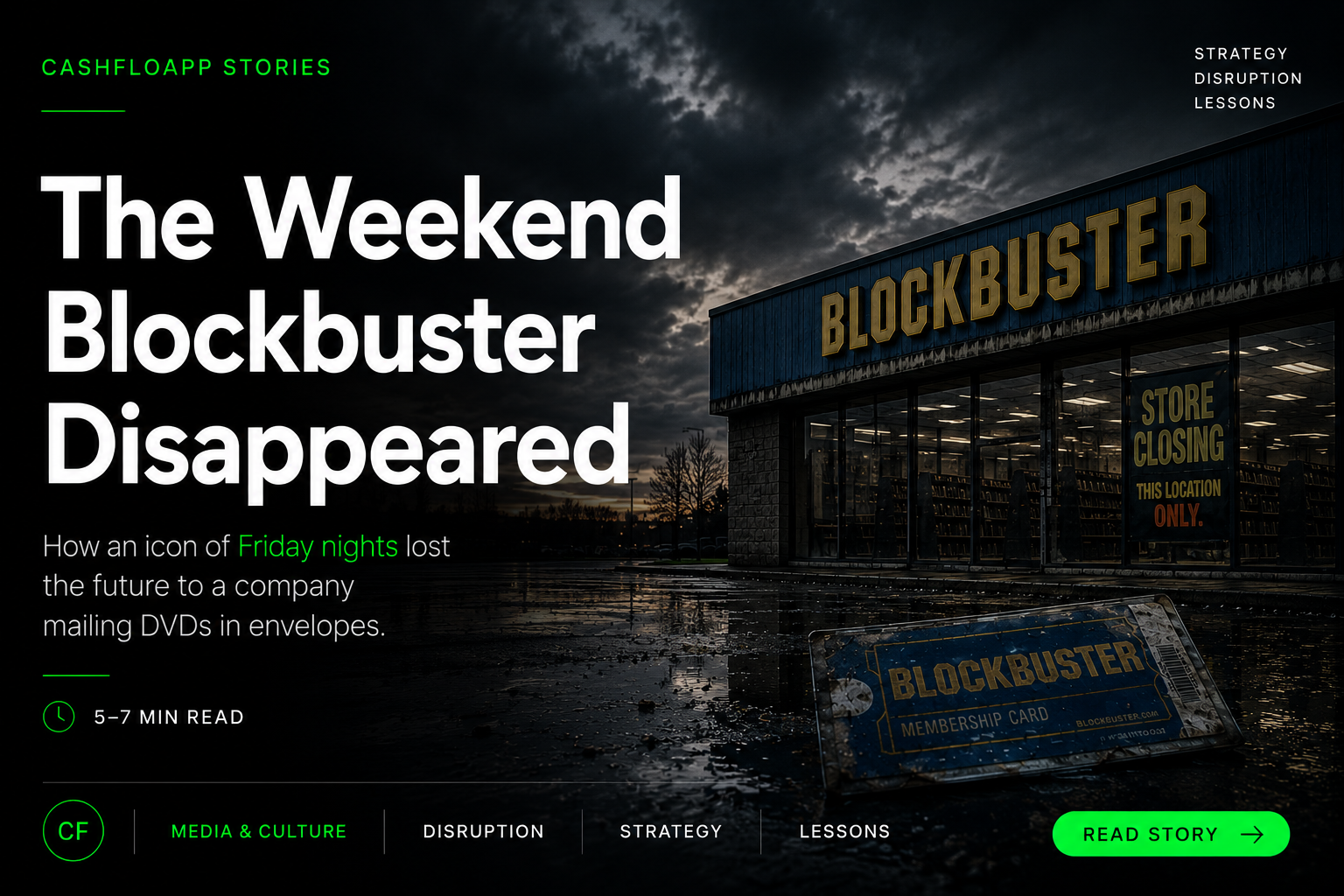
For a couple of decades, Friday night had a shape.
You drove or walked to the store with the blue and yellow sign. You split up — someone headed for horror, someone for the new releases wall, someone hunting for a case that, once opened, would almost certainly be empty. You argued about what everyone could agree to watch. Maybe you grabbed candy at the counter. You went home with a movie, and if you forgot to bring it back, you paid for that too.
If you didn't live through it, that probably sounds quaint. If you did, you can still picture the carpet.
Blockbuster wasn't just a video store. At its peak, around 2004, it ran something close to 9,000 stores worldwide, pulled in roughly $6 billion a year, and counted its members in the tens of millions. It had spent the better part of two decades solving one problem better than anyone else on earth: how do you put a video store within reach of almost every household in America? By the early 2000s, the answer was basically "everywhere." It wasn't a company anyone expected to vanish. It was the default. Ask someone in 2003 whether Blockbuster would still exist in ten years, and you'd get a strange look.
Then a Weird Little Company Started Mailing DVDs
Netflix in 2000 was not Netflix. There was no streaming, no hit shows, no 300 million subscribers. There was a small, unprofitable company in California mailing DVDs to people's houses in red envelopes, still trying to work out whether the idea would ever make money.
Early that year, its two founders flew to Blockbuster's Dallas headquarters with a pitch: Blockbuster would buy Netflix, and Netflix would run its online business going forward. The number they floated was $50 million. Blockbuster said no.
That's become one of the great cautionary tales in business — the giant too arrogant to see the threat sitting across the table. It's also, on closer inspection, a cleaner story than the actual history. Blockbuster's CEO at the time has since said he wasn't even in the room for the meeting people love to retell, and that there was never a serious offer on the table, just a passing number thrown out near the end of a bigger conversation. Nobody disputes that Netflix came knocking, or that Blockbuster passed. Everyone disagrees about how dramatic the moment actually was.
Here's the more interesting question underneath the myth: even taken at face value, would buying Netflix have looked smart in 2000? The dot-com bubble was collapsing. Netflix was losing money with no clear path to making any. DVD-by-mail was a strange little service for a few hundred thousand people. Blockbuster had just gone public and had hundreds of millions of dollars sitting in the bank. Fifty million dollars for a money-losing experiment run by a handful of people in California wasn't an obvious bet anyone was tragically missing. It was a reasonable pass.
That's the part hindsight erases. It's easy to laugh at a decision once you already know the ending.
There's something almost funny about it anyway. Blockbuster had spent two decades figuring out how to get a video store as close as possible to every household in America. Netflix's actual breakthrough wasn't some piece of futuristic technology. It was an envelope. It simply moved the store the last few miles, straight to the mailbox. Later, even the envelope turned out to be unnecessary.
The $50 million meeting makes a great story. It just isn't why Blockbuster died.
The Trap Hiding Inside the Success
Here's what actually killed the company.
Blockbuster's whole advantage was that there was a store near you. That took thousands of buildings, thousands of employees, and shelves that had to be restocked constantly so the new releases wall didn't sit empty on a Friday night. That was the machine that made Blockbuster Blockbuster. It was also enormously expensive to keep running the moment people stopped needing to get in a car.
Then there were late fees. Customers hated them. Blockbuster needed the money they brought in more than anyone wanted to admit — out loud enough that when the company finally started scrapping them, the hole in its revenue was real and immediate. The thing everyone complained about was also one of the things keeping the lights on.
That's the whole problem in a sentence: everything that had made Blockbuster powerful for twenty years came with a bill attached, and the bill only showed up once the world changed. Stores were a strength right up until they became overhead. Late fees were revenue right up until they became the reason people resented the brand. Nothing Blockbuster built was ever purely good or purely bad. It just quietly flipped, once the ground underneath it moved.
But here's the part most people don't know: Blockbuster actually fought back. It launched an online subscription. It let people order DVDs through the mail and return them at any store. It started killing the late fees everyone hated. For a while, it worked well enough that Netflix was genuinely rattled. The problem was that fighting Netflix meant attacking Blockbuster. Cutting late fees made customers happier and drained real money. Pushing people online was smart for the business Blockbuster needed to become, and terrible for the nine thousand stores it already was. Investing seriously in the future meant spending money to weaken the present — and a boardroom fight over exactly how much of that the company could stomach eventually cost the CEO who'd built the plan his job.
“Blockbuster had actually found the future. It just happened to be terrible news for Blockbuster.”
Ten years after Netflix walked into that Dallas boardroom with its strange little mail-order idea, Blockbuster filed for bankruptcy.
The Part That Isn't Really About Blockbuster
We like to imagine failing companies looking like failing companies. Empty stores. Falling sales. Panicked executives. Customers walking out the door.
But the dangerous moment usually comes earlier than that, while everything still looks fine. Blockbuster's stores still had customers in 2005. People were still renting movies every weekend. The company was still making billions of dollars. Nobody inside it was staring at a dying business. They were staring at a successful one, being asked to believe that the very thing making it successful might not matter much longer. Success is what gives a company the evidence to talk itself out of changing.
“Success is what gives a company the evidence to talk itself out of changing.”
That problem hasn't gone anywhere. A bank is looking at a fintech app right now and telling itself its customers still want a branch. An accounting firm is watching an AI tool do in seconds what it charges for by the hour, and telling itself clients still want a human signing off.
Somewhere, someone is saying "but our customers still want this" and they're probably right. For now. The uncomfortable part is that being right for now is exactly what makes it so easy to keep saying.
Blockbuster didn't disappear because nobody loved it. Millions did, and some of them still drive to a single surviving store in Bend, Oregon, just to stand on that carpet one more time. It disappeared because, in the end, customers loved what Blockbuster gave them more than they loved Blockbuster itself.
“The movie survived. The trip to go get it didn't.”